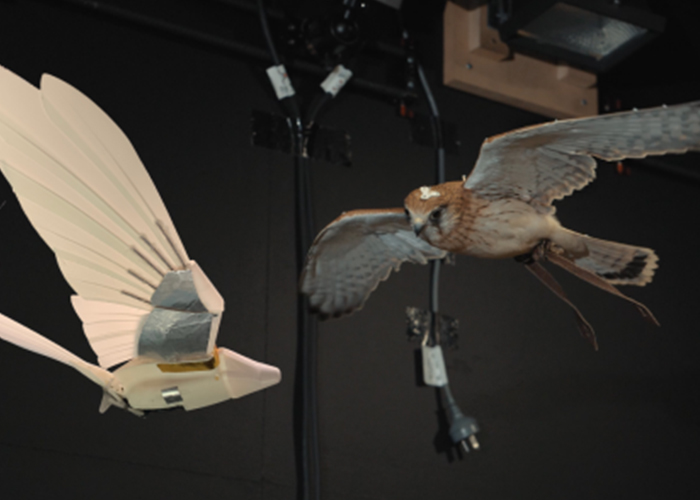
Researchers at RMIT University and the University of Bristol have developed a bio-inspired robotic bird to study how nankeen kestrels remain stable while hovering in turbulent air, with the aim of improving the performance of small unmanned aerial vehicles (sUAVs).
The work, published across two papers in the Journal of the Royal Society Interface, investigates how kestrels maintain control in gusty conditions and how those strategies could be translated into engineering approaches for aircraft that are more resilient to turbulence.
The researchers note that atmospheric turbulence is expected to increase with climate change, and that sUAVs used in aerial photography, search and rescue, agricultural monitoring and package delivery can be forced to land or avoid flights when conditions are rough.
To capture how kestrels respond to gusts, the team tracked the birds’ movements using motion capture technology in RMIT’s Industrial Wind Tunnel. RMIT researcher Matt Penn said the studies found kestrels employ multiple responses rather than relying on a single technique, including continuous adjustments of wings and tails, and the use of feather and joint flexibility to absorb sudden airflow changes.
A robotic replica designed to imitate the movements most important to kestrels’ hovering stability was then used to measure the forces involved more precisely and to test how coupled wing and tail changes influence control. Dr Mario Martinez Groves-Raines, who conducted the research while at RMIT and the University of Bristol, said the robot enabled the team to isolate specific movements and assess their contribution to steadiness in flight.
Associate Professor Abdulghani Mohamed said the findings point to potential design directions for aircraft that need to maintain control in turbulence. The researchers also said that while sUAVs already use some gust-mitigation methods comparable to those seen in birds, implementation in operational platforms is often limited by complexity and efficiency trade-offs.
The team plans to extend the work by examining how kestrels sense their environment and respond to smaller turbulence levels similar to those encountered where sUAVs commonly operate, with an aim to adapt the results to larger aircraft by simplifying the data collected.
The papers are titled ‘Bridging the Gap: A Review of Gust Mitigation in Birds and Small UAVs’ (DOI: 10.1098/rsif.2025.0978) and ‘Stability and control benefits of coupled wing and tail morphing in kestrel wind-hovering flight explored using a robot replica’ (DOI: 10.1098/rsif.2025.0930).