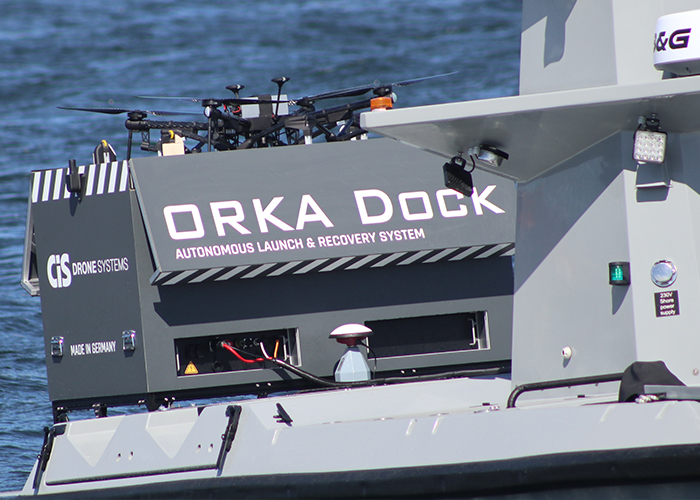
CiS has announced ORKA Dock, an automated launch and recovery hangar designed to deploy and retrieve its ORKA uncrewed aerial system (UAS) from moving maritime and mobile platforms.
The company said the system was introduced on the opening day of the Combined Naval Event in Farnborough, UK. ORKA is positioned for surveillance, reconnaissance and inspection missions over land and water, with CiS stating the aircraft offers 75 minutes of endurance and a 5.0 kg payload capacity.
According to CiS, ORKA Dock is intended to package automated launch and landing into a self-contained, enclosed deployment solution. The company said the dock enables the aircraft to launch, return-to-home and recharge without operator intervention from ships, uncrewed surface vessels (USVs), land vehicles and expeditionary sites.
CiS said ORKA Dock was designed and built in Germany using “sovereign components” and includes fast recharging, optional tether capability and battery-backup operation. The company also claimed the system can open and launch in under 30 seconds.
Before the announcement, CiS said it conducted a live demonstration at SeaSEC 2026, a naval security exercise held in April in Rostock, Germany. CiS described the demonstration as the first operational deployment of the ORKA Dock aboard a moving USV in an operational environment.
For the exercise, the system was integrated on the back deck of Q-RECON 24, a high-speed, long-range USV developed by FLANQ, which CiS described as its strategic maritime partner. CiS said the dock supported daily operations over two weeks in missions including offshore energy asset protection and harbour security.
CiS said the demonstration validated its Precision Landing System (PLS) for autonomous recovery onto a moving and pitching surface, and that the dock performed at platform speeds of up to 15 knots.
In a statement, CiS founder and CEO Tom Kaufman said the company plans to move into full-scale production following the debut of the system at the Combined Naval Event.
Image caption: ORKA Dock shown operating with FLANQ USVs. Credit: Defence Network / Navid Linnemann.