Australia’s Civil Aviation Safety Authority (CASA) has published a summary of consultation on a proposed overhaul of rules governing drone operations over or near people, a move that could reshape how commercial and public drone services are conducted in built-up areas.
The regulator’s Policy Proposal PP 2609US sets out a shift to a more proportionate, risk-based approach for remotely piloted aircraft (RPA) operating over or near people (OONP). Current settings generally prevent drones from flying over populous areas and require operators to remain at least 30 metres from people not directly involved in the operation.
CASA’s proposal would create approval-free pathways for some lower-risk activities while tightening expectations for more complex operations.
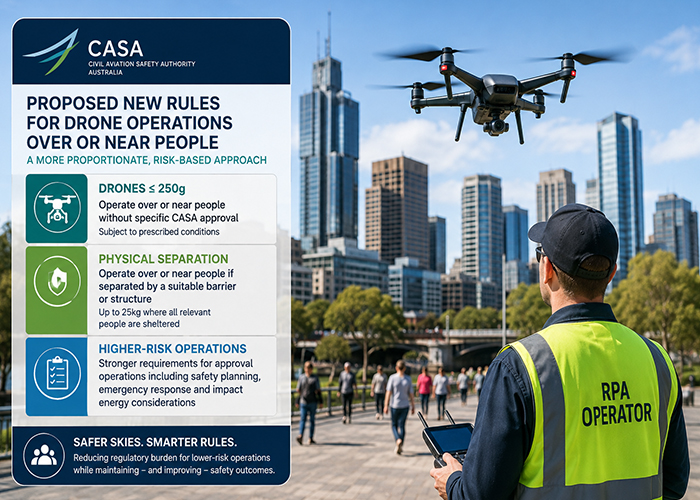
Among the most consequential changes is a proposal that drones weighing 250 grams or less could operate over or near people without specific CASA approval, provided prescribed operating conditions are met.
CASA is also proposing an approval-free pathway where people within 30 metres are physically separated from the drone by a suitable barrier or structure. The proposal indicates this could extend to drones up to 25 kilograms where all relevant people are appropriately sheltered, citing buildings and stationary vehicles as examples.
CASA has framed the changes as a move away from treating all operations near people similarly, and toward assessing operations based on the actual risk to people on the ground.
“Overall, the proposal aims to reduce approvals for inherently lower-risk operations, provide clearer expectations for industry, and focus CASA’s assessment effort on more complex and higher-risk activities, while maintaining or improving safety outcomes,” the regulator said.
For the commercial drone sector, the proposal could reduce administrative barriers for operators using micro drones or operating in controlled environments, including applications such as infrastructure inspection, emergency response, security, media, construction and surveying.
At the same time, CASA is proposing stronger requirements for operations that continue to need approval, including greater use of concepts of operations and emergency response planning. The regulator also intends to refine approval pathways to better address hazards such as laceration injuries, impact energy and operations involving moving vehicles, and to give additional consideration to flights near major gatherings and organised events.
Another proposed change affects “participating” people who actively consent to a drone operation. Under current policy, written consent is required from adult participants. The proposed framework would allow written or digitally recorded consent and introduce additional operating conditions, including a proposed aircraft weight limit of 25 kilograms.
CASA’s proposal would also broaden the framework beyond holders of a Remote Operator’s Certificate (ReOC), applying to ReOC holders as well as excluded RPA operators and Remote Pilot Licence (RePL) holders undertaking certain lower-risk operations.
The consultation process included industry engagement through CASA’s Aviation Safety Advisory Panel and a seven-member technical working group established in December 2025 to provide feedback on revisions to CASA’s existing policy (TMI 2024-01) on RPA operations over or near people. Public consultation opened on 22 April 2026 and, after an extension, closed on 31 May 2026. CASA has said it is reviewing submissions and will publish a Summary of Consultation outlining feedback received, intended changes and next steps.
CASA has also flagged that not all elements of the proposal would necessarily be implemented immediately, with consultation outcomes potentially informing longer-term policy, guidance material and future legislative or regulatory amendments.
The regulator has positioned PP 2609US within broader work under its RPAS and Advanced Air Mobility regulatory roadmap, including initiatives covering airworthiness, operational risk assessment and infrastructure to support more sophisticated uncrewed aviation operations.
CASA’s consultation summary reports that respondents broadly supported a risk-based approach, but sought clearer, practical guidance and more proportionate approval processes. CASA said the feedback will inform further policy development and work to support any future changes, including updated assessment frameworks, training resources and transition arrangements.