Uvision and Wayland Autonomy have announced the integration of Wayland’s IRIS airborne imaging payload into Uvision’s Tactical CORTEX architecture, in a move aimed at expanding airborne intelligence, surveillance and reconnaissance (ISR) options in contested environments.
The companies said the integration is intended to extend Tactical CORTEX’s sensing layer with wide-area airborne ISR and onboard target generation, supporting missions where GPS is degraded or unavailable.
Tactical CORTEX forms part of Uvision’s sensor-to-effect approach, providing situational awareness and a multi-platform mission-management layer intended to work across different sensing assets and effectors.
Wayland Autonomy described IRIS as a compact, platform-agnostic airborne ISR payload designed for wide-area mapping and target generation, including in GPS-denied environments. The company said the payload uses AI-enabled onboard processing and communications-independent navigation to generate georeferenced imagery and targeting information in flight, and to maintain geolocation through jamming, spoofing and GPS denial. It said the dual-channel payload supports day and night operations and provides wide-area coverage at 2–7cm resolution, with collection coverage rates reaching over200 km² per hour.
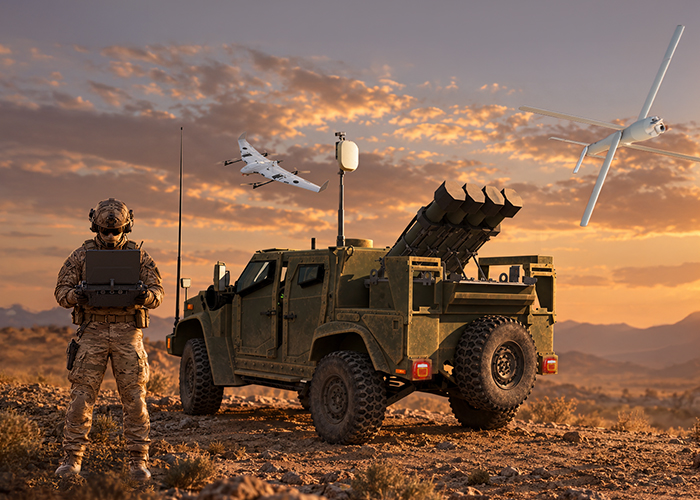
In the announcement, the companies said a HERO 400Q equipped with IRIS could be used for longer-range ISR and battle damage assessment in support of distributed HERO formations and other strike assets. They also said the HERO 120Q could operate as an ISR “Launched Effect” to provide reconnaissance and target generation for tactical forces, including for air-launched missions as well as ground- and maritime-launched operations.
IRIS can also be integrated on third-party airborne platforms, according to the companies, allowing the same sensing capability to be used across different mission profiles and ranges.
“This integration is another example of how our systems are designed from the outset to support a Modular Open Systems Approach (MOSA)”, said Itzik Huber, General Manager of Uvision Inc.
Wayland Autonomy co-founder and CTO Eatay Ben Shechter said generating reliable targeting information over wide areas in real time when GPS is degraded or denied remains a significant challenge for airborne ISR, and said the integration is intended to connect IRIS-generated intelligence to the operational sensor-to-effect chain.