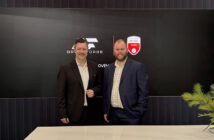
HII has launched a new automation initiative with Path Robotics and GrayMatter Robotics aimed at increasing production throughput in U.S. naval shipbuilding.
Announced at the U.S. Navy League Sea-Air-Space Expo 2026, the High-Yield Production Robotics (HYPR) program will draw on what the companies describe as emerging “physical AI” technologies to automate parts of the fabrication process for both crewed and uncrewed naval platforms.
According to HII, HYPR will combine robotic welding, automated material movement, autonomous surface treatment and autonomous quality checks into an assembly-line model intended to improve the speed and efficiency of ship and submarine construction. HII said it plans proof-of-concept demonstrations with its partners in 2026, with a full pilot program expected to launch in 2027.
HII executive vice president of maritime systems and corporate strategy Eric Chewning said the company expects the approach to reduce labour hours per hull and improve schedule predictability on complex shipbuilding tasks that have been difficult to fully automate.
The program is being developed with support from HII’s Dark Sea Labs Advanced Technology Group. HII positioned the effort as part of a broader push within U.S. defence to expand naval capacity and modernise shipbuilding methods, noting ongoing constraints in producing critical material for integration into Navy platforms.
HII said HYPR is designed for adaptive automation across structural fabrication, including cutting and fitting parts, surface preparation, welding, inspection, blasting and coating. The program is intended to integrate multiple systems into a coordinated production line rather than deploy standalone automation tools.
Under the arrangement, Path Robotics will contribute technology focused on automating welding, while GrayMatter Robotics will provide automation for surface preparation, finishing, coating and inspection. The companies said their combined systems are intended to address interconnected fabrication steps that affect cost, schedule and reliance on outside suppliers in major naval programs.
HII said it will provide shipbuilding expertise, production demand and qualification pathways. It said partners will contribute engineering investment and deliver materials alongside automation systems that can be scaled across programs.
HII said the pilot is expected to support structural needs for its ROMULUS unmanned surface vessel family, as well as structural assemblies for surface combatants and submarines. The company also linked the initiative to wider industrial cooperation efforts, including AUKUS-related submarine industrial base work and distributed production strategies among allied shipbuilders.