DroneShield has released its Q4 2026 software update, which it says is designed to help operators detect and classify drone threats earlier, including previously unseen or modified models.
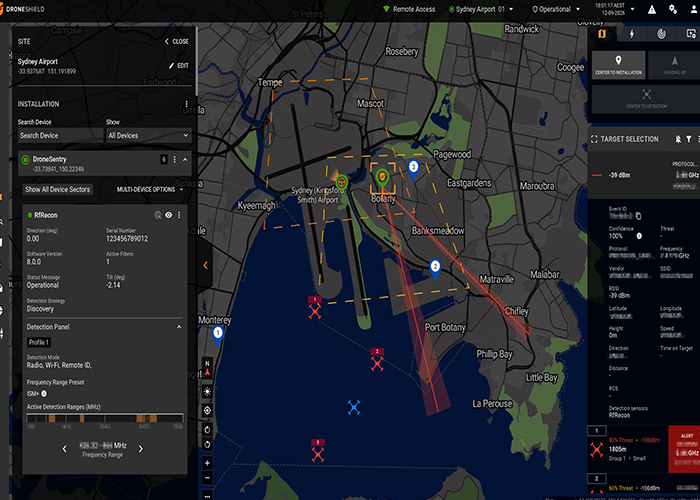
The company said its RfRecon capability can now flag signals that “behave like drones” even if they are not yet included in DroneShield’s threat library, and display them in the DroneSentry-C2 command-and-control dashboard. DroneShield said this is intended to shorten the time between an emerging drone model appearing and operators being able to investigate it.
In its update notes, DroneShield reported improvements in sensor classification intended to reduce false positives and missed detections. It said thermal camera classification accuracy improved by 44%, and fixed-wing drone identification improved by 18% in precision and 8% in recall. The company also said target detection in standard video has been improved.
The release also introduces tighter integration between radio frequency sensing and optical cameras, aimed at enabling visual confirmation without emitting radar signals. DroneShield said that with compatible Bosch Starlight cameras, the system can steer cameras along the bearing of a radio detection, then lock on and track the target.
For its DroneSentry-X Mk2 units, DroneShield said detections can now be shared between connected units, enabling multiple systems to respond to the same target. The company also said the jamming function can be limited to the frequencies a specific drone uses, which it said is intended to reduce interference with other nearby systems.
DroneShield said the update includes a streamlined user interface and connectivity configuration, and adds compatibility with Sentrycs firmware version 6.7.1 for layered deployments.
The company said the release is available through its Mission Ready Services subscription and can be deployed to “more than 4,200” software-enabled devices already in the field, without requiring new hardware.
Chief executive Angus Bean said the software release was intended to keep pace with evolving drone threats and provide “better information and a more focused response” to operators using deployed systems.