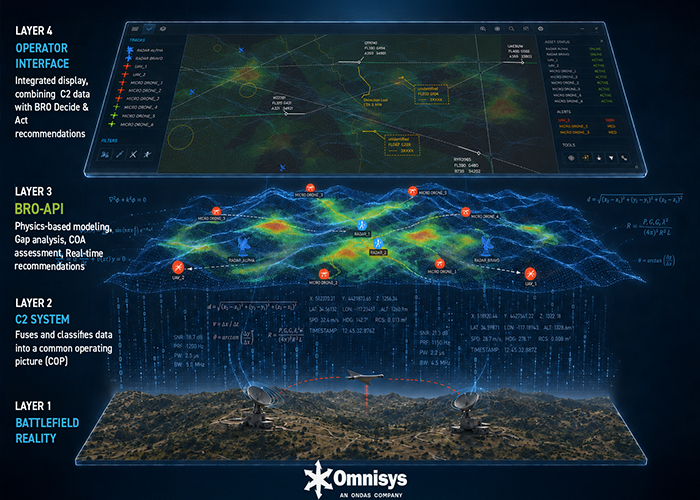
Omnisys, an Ondas Inc. company, has announced BRO-API, a bidirectional integration layer designed to connect its BRO (Battle Resource Optimization) mission planning and decision-support platform with existing command-and-control (C2) and command, control, communications, computers and intelligence (C4I) systems.
The company says the aim is to shorten decision cycles by continuously synchronising BRO with the live operational picture, moving the tool from a standalone mission planning platform to an integrated capability that exchanges information throughout a mission.
According to Omnisys, BRO uses situational awareness data from C4I systems to support “situational understanding”, evaluate operational alternatives, optimise the deployment of sensors and effectors, and generate courses of action. With BRO-API, those functions are intended to extend into the Decision and Act phases of the OODA loop (observe, orient, decide, act), enabling ongoing re-planning as conditions change.
Omnisys says the interface continuously ingests updated operational data, including blue force deployment and readiness, operational events and the red force picture, and produces recommendations including deployment, routing and frequency allocation. Mission re-planning outputs and operational insights are then fed back into the C2/C4I system.
The company says BRO-API is designed for defence environments, including operation on classified and disconnected networks, controlled permissions, secure message logging and RESTful integration. Omnisys also states the interface follows defence interoperability principles and is intended to support future compatibility with NATO and US military standards.
Omnisys says BRO-API also supports after-action review by maintaining mission lifecycle data for lessons learned and continuous improvement.
“BRO has always enabled commanders to optimize their plans before the mission begins,” said Alfred (Fredi) Tzimet, deputy CEO of Omnisys. “BRO-API is the next step in that evolution, extending those capabilities throughout mission execution so commanders can continuously optimize operations as the battlefield evolves.”