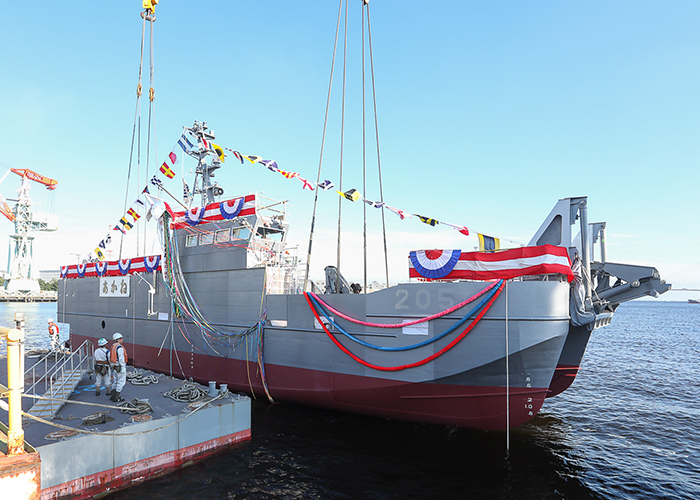
The first CAIMEN Japan high-speed landing craft, based on a platform design provided by BMT and with detailed design and construction undertaken by Japan Marine United Corporation (JMU), has been launched as part of Japan’s next-generation High Speed Landing Craft programme (輸送艇) for the Japan Self-Defense Force (JSDF).
The launch follows the December 2025 contract award by Japan’s Acquisition, Technology and Logistics Agency (ATLA) to JMU for design and build of the next-generation High Speed Landing Craft. Under the programme, BMT provides the CAIMEN landing craft design, while JMU undertakes production design and construction at its facilities in Japan.
The vessels are set to serve with the JSDF’s Maritime Transport Group, a joint unit of the Japan Maritime, Ground and Air Self-Defense Forces established in March 2025 to support rapid movement of personnel, vehicles and equipment between sea and shore, including to remote islands in Japan’s southwestern region where port facilities are limited.
According to BMT and JMU, CAIMEN Japan is approximately 35 metres long, of aluminium construction, and incorporates BMT’s tri-bow hull form. It is designed to achieve speeds of about 18 knots while carrying vehicles and personnel, and to support beaching operations.
The companies said the launch is the first application of a BMT design to a Japanese shipbuilding programme. The CAIMEN family has also been used internationally, including in the U.S. Army’s Maneuver Support Vessel (Light), which the release described as an evolution of the BMT CAIMEN-90 adapted through the Vigor–BMT partnership and now in full-rate production.
Graeme Nayler, managing director – Asia Pacific at BMT, said the launch was significant because it involved an overseas vessel design being adopted for a Japanese defence programme. He said the project also reflected growing defence industrial links between the United Kingdom and Japan.
Eto Atsushi, JMU director and managing officer, said the companies would move into the final phase toward delivery, with a focus on safety, quality and performance.
The programme sits against a wider backdrop of increased regional focus on maritime mobility and logistics, particularly for operations in littoral environments and island chains. High-speed landing craft can support rapid transport and resupply where fixed infrastructure is limited, and contribute to distributed operations concepts adopted by several militaries in the Indo-Pacific.