Australia has unveiled a new generation of mission payloads for its Ghost Shark autonomous underwater vehicle, expanding the platform’s potential roles in undersea warfare, maritime strike, seabed operations and the protection of critical infrastructure.
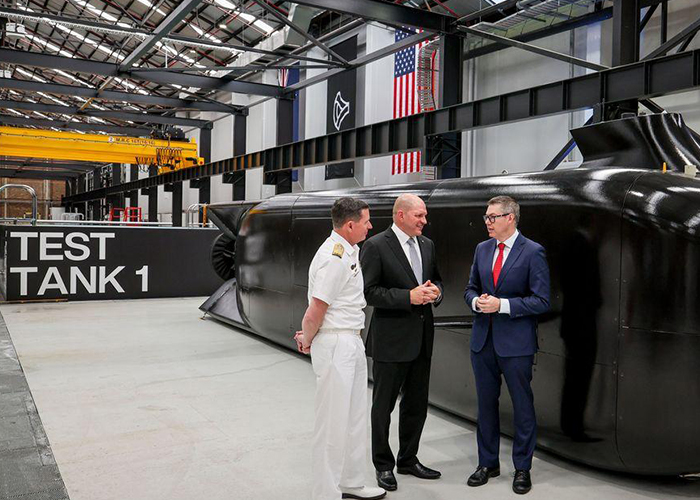
Defence Industry Minister Pat Conroy announced the developments on Monday, 19 October, during a visit to Anduril Australia’s manufacturing facility in Sydney, alongside senior Royal Australian Navy and Defence science representatives.
The announcement comes ahead of Exercise Maritime Big Play Pacific, an AUKUS Pillar II activity being conducted in San Diego, where Australia will demonstrate advanced autonomous maritime technologies alongside the United States and United Kingdom.
For the first time, Defence has publicly detailed the development and integration of operational payloads for Ghost Shark, Speartooth uncrewed underwater vehicles and the BlueBottle autonomous surface vessel.
The systems are being developed to support a range of missions, including remote deployment of sea mines, supply caches and uncrewed aerial vehicles, as well as the potential employment of underwater weapons.
According to the joint ministerial statement, the modular architecture of these platforms enables payloads to be adapted to specific operational requirements, allowing the Navy to expand their roles as new technologies become available.
Speaking at the facility, Conroy said Ghost Shark demonstrated progress in Australia’s defence industry.
“Ghost Shark is a flagship Australian success story that showcases the ingenuity of our defence industry and the value of investing in sovereign capability,” Conroy said.
“Our Government opened this factory less than a year ago and Ghost Sharks capable of a range of complex missions operating far from our shores are now rolling off the line at an increasing rate into the hands of the Australian Navy.”
The Government has committed $1.7 billion to acquire a fleet of Australian-designed and manufactured Ghost Shark extra-large autonomous underwater vehicles, with Anduril Australia responsible for production and continued development.
The broader investment in autonomous and uncrewed undersea warfare capabilities is expected to reach up to $5.8 billion over the decade under the 2026 National Defence Strategy and Integrated Investment Program.
The investment reflects Defence’s increasing emphasis on autonomous platforms that can extend Australia’s maritime reach, conduct persistent operations and reduce the exposure of crewed ships and submarines in contested environments.
Expanded strike and undersea capabilities
At the Sydney announcement, Anduril Australia chief executive David Goodrich outlined the development of several new Ghost Shark payload configurations.
These include the ability to deploy tube-launched ALTIUS loitering munitions, potentially allowing the underwater vehicle to launch aerial systems into the battlespace without requiring a crewed vessel to enter the operating area.
Goodrich also confirmed that Ghost Shark’s large modular payload bays are designed to accommodate heavyweight and lightweight torpedoes, along with other underwater effectors.
The capability would expand Ghost Shark beyond intelligence collection and surveillance into offensive undersea warfare, although Defence has not disclosed the operational readiness, testing status or deployment timetable for each weapon configuration.
Goodrich said the platform’s open-system architecture would enable new payloads to be integrated as technologies mature.
The company also confirmed that more than 42 Australian businesses are participating in the Ghost Shark production programme, with manufacturing activity increasing following the transition from prototype development to fleet production.
Anduril said the first production delivery to the Royal Australian Navy occurred three months after the signing of the $1.7 billion production contract.
AUKUS cooperation and the future of Australia’s autonomous fleet
The announcement also included a new anti-submarine warfare capability for the Australian-developed BlueBottle autonomous surface vessel.
Conroy confirmed that BlueBottle would be equipped with a thin-line towed-array sonar designed to detect submarines, extending its potential role in persistent maritime surveillance.
Chief of Navy Vice Admiral Matt Buckley said the development of modular payloads across Ghost Shark, Speartooth and BlueBottle would allow the Navy to adapt autonomous systems to changing operational requirements.
He said the objective was to integrate these platforms into a combined fleet of crewed and uncrewed vessels, supporting undersea warfare, sea denial and the protection of critical subsea infrastructure.
The announcement is particularly relevant to AUKUS Pillar II, which focuses on cooperation in advanced defence technologies rather than the nuclear-powered submarine acquisition programme under Pillar I.
Australia, the United Kingdom and the United States have identified common payloads and enabling systems for autonomous underwater vehicles as a priority collaborative project.
The forthcoming San Diego exercise will provide an opportunity to test and demonstrate selected technologies, although Defence has not specified which of the newly announced payloads will participate or the extent of their operational evaluation.
Conroy also confirmed that Australia is pursuing potential export opportunities for Ghost Shark, while noting that the immediate AUKUS focus remains on common sensors and payloads rather than the acquisition of a shared underwater vehicle platform.
The developments represent an expansion of Australia’s autonomous maritime ambitions, moving beyond surveillance and reconnaissance towards systems capable of delivering weapons and other mission effects across contested maritime environments.
However, questions remain about the maturity of individual payloads, their integration into Navy operations and the extent to which autonomous strike capabilities will be governed by human command and control arrangements.
Defence has not publicly disclosed the full operational specifications, deployment numbers or timelines for the newly announced weapon systems.
For Australia’s defence industry, the programme provides an important test of whether rapidly developed autonomous technologies can transition into sustained production, operational integration and potential international exports.
The announcement also signals a broader shift in Australian maritime defence planning, with autonomous systems increasingly positioned as complementary capabilities alongside the Navy’s existing submarines and future nuclear-powered fleet.