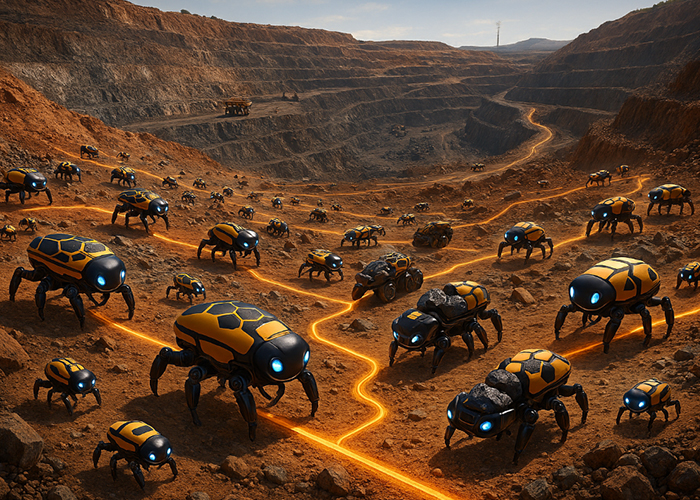
Researchers at Adelaide University have developed and tested a swarm robotics approach for mining automation, drawing on how bees and ants coordinate to search for and transport resources.
The work, published in Natural Sciences, examines decentralised control in teams of small robots, aiming to reduce reliance on a single control centre and improve resilience if individual units fail.
The researchers positioned the work against operational challenges in mining as activity moves into deeper, more remote and harder-to-access locations. They said many existing automated systems can be expensive or inflexible and may be vulnerable if a central control system fails.
In a laboratory set-up designed to mimic a mine, the team used small Zumo 2040 robots to test three strategies: a basic model in which robots collect ore and immediately return; an ant-inspired model where robots share tasks; and a honeybee-inspired model where robots first explore and map an area before collecting resources.
Lead author Dr Joven Tan, who conducted the research as part of a PhD in the School of Chemical Engineering, said the study indicates social-insect behaviours can inform robotics design for industrial settings. “Social insects have developed very efficient ways of solving problems together,” Tan said.
Across the tests, the honeybee-inspired method performed best, according to the researchers, by exploring first and remembering resource locations. The team reported it reduced travel distance by up to 80%, cut energy use by about 50%, and completed ore delivery tasks up to 60% faster than the basic approach.
The ant-inspired method also improved outcomes by splitting roles between robots, with one locating resources and another transporting them.
Project leader and co-author Dr Noune Melkoumian, also from the School of Chemical Engineering, said the group’s objective was to demonstrate feasibility beyond simulation, using real robots in a lab environment intended to replicate aspects of mining operations.
The researchers said further development would be required before deployment in operational mines, including sensor improvements, longer battery life and the ability to handle unpredictable underground conditions. They also pointed to potential uses in hazardous or difficult-to-reach areas, and in future space mining concepts where autonomy would be required.
‘Bio-Inspired Swarm Robots Design for Mine Automation’ is published in Natural Sciences. DOI: 10.1002/ntls.70049.