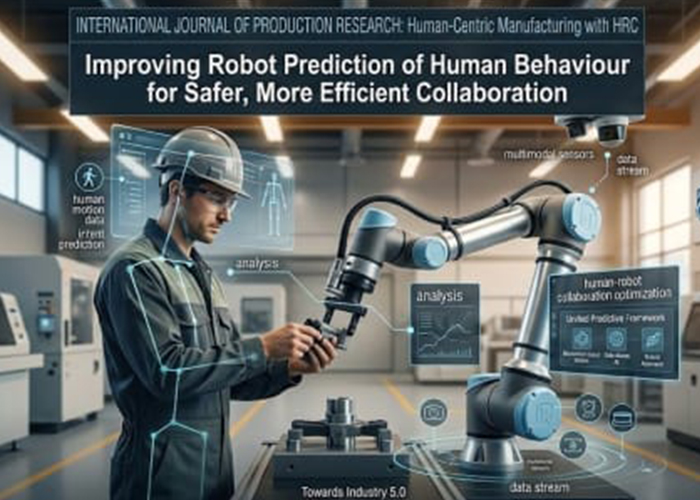
A new review published in the International Journal of Production Research examines how manufacturers can improve safety and coordination in human-robot collaboration by strengthening the way robots predict human behaviour in shared industrial environments.
The Monash University-led review comes as manufacturers move toward “Industry 5.0”, a model that emphasises more human-centred production systems combining human judgement and dexterity with robotic precision and speed.
The authors argue that closer physical proximity between workers and robots increases operational risks if robots cannot accurately anticipate what a person will do next, potentially leading to collisions, delays and reduced efficiency.
The paper surveys three broad approaches to human behaviour prediction in human-robot collaboration: mechanism-based models based on motion and interaction rules; data-driven models using sensors and artificial intelligence; and hybrid approaches that combine both.
While each method has strengths, the review suggests more integrated approaches are likely to be better suited to future human-centric manufacturing systems.
The researchers identify several continuing challenges, including variability in human behaviour, a lack of standardised multimodal datasets, limitations in physical world models, and the need to better account for human trust, workload and cognitive state during collaboration.
To address those gaps, the authors propose a unified framework integrating multimodal data, physical world modelling, behaviour prediction and adaptive control.
Co-author Yunlong Tang, Assistant Director of the Monash Centre for Additive Manufacturing and a senior lecturer in mechanical and aerospace engineering and materials science and engineering, said improvements in how robots interpret and respond to human behaviour would be important for the next generation of manufacturing systems.
“Industry 5.0 is about designing manufacturing systems around people as well as technology. By improving how robots predict human behaviour, we can move towards production environments that are not only more productive, but also safer, more adaptive and more human-centred,” Tang said.
The review concludes that progress is likely to depend on combining physical models, sensor data and AI so robots can respond more intelligently to human movement, intent and changing working conditions.
The paper is available at: https://doi.org/10.1080/00207543.2026.2639732