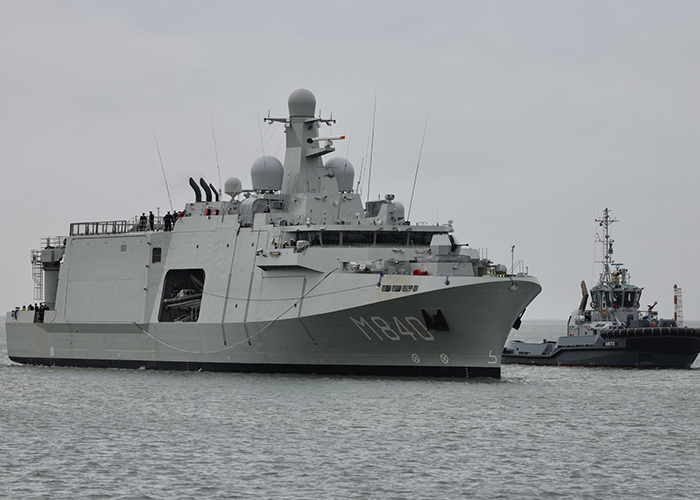
The second mine countermeasure vessel under the Belgian-Dutch rMCM (replacement Mine Counter Measures) programme has been delivered, marking a milestone in European naval cooperation and a first for the Royal Netherlands Navy.
The vessel, HNLMS Vlissingen, was formally handed over on 27 February 2026 in Den Helder. It is the first ship in the programme delivered to the Netherlands and the second overall in the 12-vessel joint fleet being developed for Belgium and the Netherlands.
The ceremony was attended by senior naval and industry officials, including Vice Admiral Jan Willem Hartman, Commander of the Materiel and IT Command, Navy Captain Ludo Portier, Head of Procurement Naval Systems, Navy Captain Kurt De Winter, Director of Operations of the Belgian Navy, Vincent Martinot-Lagarde, Executive Vice President for Surface Ships at Naval Group, and Steven Luys, CEO of Exail Robotics Belgium.
The delivery represents an unusual industrial arrangement within NATO: a Royal Netherlands Navy vessel built under contract by the Belgian Ministry of Defence, with Belgium acting as lead nation in the binational programme under the long-standing BeNeSam naval cooperation framework.
Captain Ludo Portier described the transfer as a historic step within the cooperation model, noting that for the first time a Dutch naval vessel had been procured under a Belgian-led contract structure. Industry partners framed the event as evidence of deepening operational and procurement integration between the two navies.
The rMCM programme was awarded in 2019 to Belgium Naval & Robotics, a consortium formed by France’s Naval Group and Exail. A tripartite agreement signed in September 2023 between France, Belgium and the Netherlands further formalised cooperation in mine warfare.
A shift in mine warfare doctrine
Beyond the symbolic dimension, Vlissingen represents a significant shift in mine countermeasure doctrine. Rather than traditional minehunter operations in which the vessel itself enters contested waters, the new ships are designed around a stand-off concept, keeping the mother ship and crew at distance while deploying unmanned systems into hazardous zones.
The integrated system is designed to detect, classify, identify and neutralise mines using a fully robotic architecture. According to programme partners, the approach can increase mine clearance speed by up to ten times compared with conventional methods, although operational performance will ultimately depend on mission conditions.
The vessels are also engineered to withstand underwater explosions and to maintain low acoustic, electrical and magnetic signatures — critical characteristics for mine warfare operations.
Technical profile
Vlissingen measures 82.6 metres in length with a beam of 17 metres and a displacement of 2,800 tonnes. It has a maximum speed of 15.3 knots and a range exceeding 3,500 nautical miles. Accommodation is provided for 63 personnel.
The ship’s core capability lies in its embarked autonomous systems suite, built around Exail’s UMISOFT system. This includes:
-
Two 12-metre Inspector 125 surface drones
-
Three A-18 autonomous underwater vehicles equipped with UMISAS 120 sonar
-
Two towed sonars planned (T-18 with UMISAS 240 sonar)
-
Two mine identification and neutralisation systems (Seascan and K-Ster C)
-
Two V200 Saab Skeldar aerial drones
-
An Exail influence dredger incorporating magnetic and acoustic modules (planned)
Handling systems include side gantries for launching 19-tonne surface drones, a 15-tonne rear crane and a 3-tonne overhead crane. The vessel also carries two 7-metre SOLAS RHIBs.
Strategic implications
The delivery of Vlissingen comes at a time of renewed emphasis on maritime security in European waters, particularly in the North Sea and Baltic regions where undersea infrastructure protection has become a growing concern.
By adopting a robotics-centric approach to mine warfare, Belgium and the Netherlands are positioning their navies at the forefront of autonomous naval operations within NATO. The programme also reflects a broader European defence trend: pooling procurement, harmonising capability development and leveraging industrial partnerships across borders to reduce duplication and strengthen collective readiness.
While the real-world operational impact of the new class will only become clear through deployment, the rMCM programme is already being viewed as a test case for how smaller European navies can jointly field advanced, high-technology capabilities without sacrificing sovereignty or interoperability.