Omnisys has unveiled the latest evolution of its BRO™ (Battle Resource Optimization) suite, introducing an AI-powered Counter-Unmanned Aircraft System (C-UAS) mission-planning platform designed to shift counter-drone operations from reactive interception to proactive threat prevention.
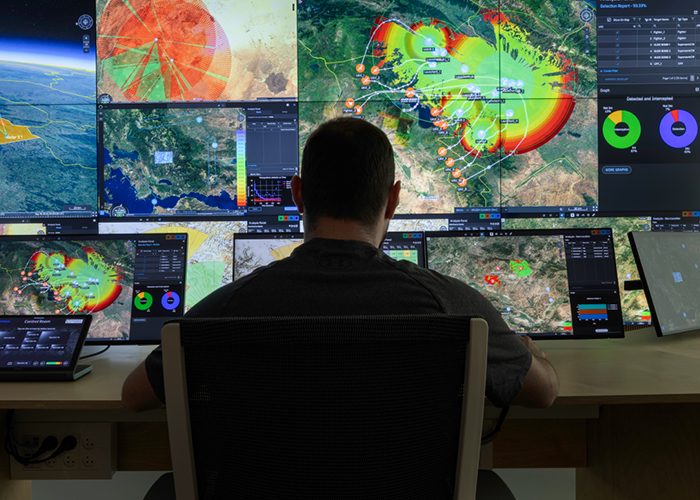
The new BRO™ C-UAS capability builds on the company’s established BRO-CUAS system and uses a physics-accurate digital twin of the battlespace to model terrain, infrastructure and spectrum effects in detail. The platform enables operators to anticipate likely drone attack routes, identify coverage gaps and blind spots, and optimise the deployment of existing counter-UAS assets against small drones, FPV strike systems and loitering munitions.
By modelling real detection, tracking and engagement envelopes for sensors and effectors, BRO™ C-UAS reveals low-altitude approach corridors shaped by terrain, buildings and vegetation. This allows planners to prioritise critical sites and routes, close vulnerabilities, and position radars, RF sensors, jammers and interceptors where they deliver the greatest operational effect under real-world conditions.
An AI-driven optimisation engine evaluates multiple deployment options and operational concepts, recommending courses of action that improve coverage and interception probability while reducing mutual interference and unnecessary overlap. The platform functions as an independent mission-planning and decision-support tool, complementing existing command-and-control and sensor-control systems rather than replacing them.
Omnisys said the system is designed to enhance mission understanding rather than simple situational awareness, helping commanders make faster and more informed decisions in highly dynamic environments. By modelling operational constraints and likely adversary behaviour, the platform supports mission planning, rehearsal and adaptation before systems are committed in the field.
BRO™ C-UAS is fully vendor-agnostic, allowing users to model mixed fleets of radars, electro-optical and infrared sensors, RF detectors, jammers and kinetic effectors from multiple suppliers, alongside known or generic hostile systems. Performance parameters are configured locally through a secure interface, ensuring that classified or proprietary data remains under sovereign user control.
Beyond operational use, the platform also supports training, readiness and long-term force development. Defence planners and acquisition authorities can use the system to assess alternative counter-UAS architectures, compare operational trade-offs and identify cost-effective combinations of sensors and effectors tailored to specific mission profiles and budget constraints.