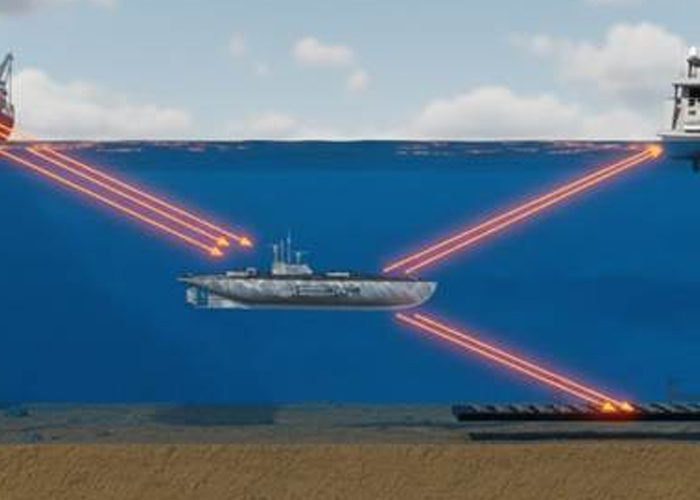
Decision Sciences International Corporation (DSIC) has secured a contract from an overseas government to develop a detection system capable of identifying so-called “narco submarines” using both passive and active charged-particle (muon) tomography. The multi-phase program will draw on the company’s existing Discovery system and its experience with high-energy particle modelling and reconstruction technologies.
The project will assess how muon tomography — a technique that uses naturally occurring or artificially generated charged particles to image dense structures — can be adapted for coastal interdiction missions. DSIC is using the GEANT-4 particle simulation toolkit to model representative submersible designs and surrounding operational environments as part of a concept of operations tailored for maritime counter-narcotics tasks.
The company is evaluating two passive muon-based approaches that could be deployed in the near term, along with two active concepts. One of the active approaches uses a lower-energy particle source, while another explores a laser–plasma wakefield system with longer-term potential but requiring additional development work.
“Decision Sciences is delighted to have earned the confidence of another important Government customer that has engaged our talented team to address a significant source of narcotics smuggling,” said Stuart J. Rabin, Chairman and CEO of Decision Sciences. “We are excited to extend DSIC’s proprietary Charged Particle (Muon) Tomography technology into new passive and active muon solutions, building on our unique expertise and the lessons learned from commercial deployments of our groundbreaking Discovery system.”
DSIC’s existing Discovery platform uses AI, machine learning and physics-based models to detect contraband, anomalies and human presence in cargo and vehicles at ports, borders and critical infrastructure sites. The new program extends this technology to the maritime domain, where semi-submersible vessels used for drug trafficking present substantial detection challenges due to their low profiles, composite materials and limited radar signature.