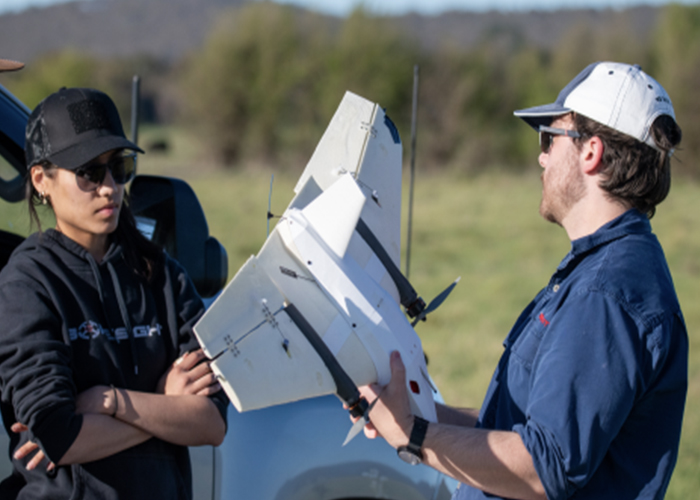
Charlize D’Souza, an aerospace research and design engineer at Australian defence technology company Boresight, has been working on the development of the company’s BF100 fixed-wing aerial target drone, after joining the business as a graduate engineer in 2025.
D’Souza said her interest in engineering started with her father, and was reinforced at school through STEM subjects. She completed a Bachelor of Aeronautical Engineering (Honours) at the University of Sydney, graduating at the start of 2025, and participated in the SUAVE (Sydney UAV Engineering) student team, including its Design Build Fly group.
D’Souza said job opportunities for aeronautical engineers in Australia were limited, and she was looking for work that would keep her in aviation. She said she first connected with Boresight through SUAVE, which the company sponsors, and later attended a company open night where she met Chief Technology Officer Dr Alexander Hall and other staff.
Boresight develops aerial target drones used to simulate adversary aircraft for training and testing. The company positions the systems as supporting counter-uncrewed aerial systems (C-UAS) training and evaluation, allowing military users to rehearse detection, tracking and engagement and assess counter-drone capabilities without risking operational aircraft.
The company manufactures in Fyshwick in the ACT and is building manufacturing capability in Huntsville, Alabama. It said it has teams in Australia, the US and Europe, and customers including the Australian Defence Force and US Army training facilities.
D’Souza said she was assigned requirements for the BF100 and was responsible for progressing the aircraft from concept through to flight testing. She said the work required a different approach to other Boresight platforms, which have used additive manufacturing methods including FDM and SLS printing.
She said early BF100 prototypes were not produced using 3D printing because printed parts were too fragile and time-consuming to manufacture for the design goals, and she moved to experimenting with expanding foams and developing a new manufacturing process before producing prototype components.
D’Souza said a series of flight tests informed design iterations until the BF100 was flying and meeting requirements, and credited support from colleagues for feedback and technical guidance.
Boresight said the BF100 is being demonstrated to international military customers.