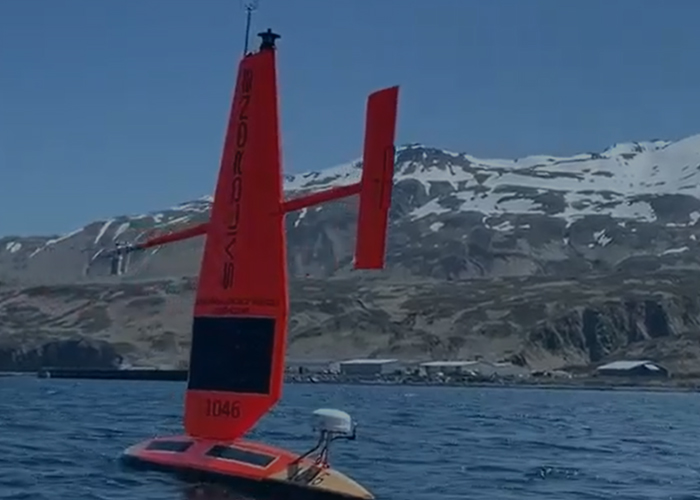
The first of a new fleet of uncrewed surface vehicles (USVs) departed from CSIRO Hobart this week as part of a long-term effort to improve measurements of how much carbon dioxide (CO₂) the Southern Ocean absorbs from the atmosphere.
CSIRO said the wind- and solar-powered USVs, built by Saildrone, will be deployed quarterly over five years to circumnavigate Antarctica and operate for months at a time in remote waters, transmitting data in real time. The project aims to address limited observations in seasons and regions where conventional ship-based sampling is sparse.
The mission is part of an international collaboration involving CSIRO, the Australian Antarctic Program Partnership, the US National Oceanic and Atmospheric Administration (NOAA), South Africa’s Southern Ocean Carbon-Climate Observatory (SOCCO) at CSIR, Columbia University, the University of Washington, Schmidt Sciences through the Virtual Institute for the Carbon Cycle (VICC) program, and Saildrone.
Oceans store about a third of the CO₂ absorbed from the atmosphere each year, with the Southern Ocean accounting for around 40 per cent of global ocean CO₂ uptake, according to CSIRO. Researchers involved in the project said more data is needed to better estimate the scale of absorption and the factors influencing it.
CSIRO scientist Dr Elizabeth Shadwick said the campaign is intended to collect measurements in under-sampled areas and times of year. Shadwick said each Saildrone deployment is expected to cover about 22,000 kilometres, expanding observation coverage beyond what is typically possible using research vessels and commercial shipping routes.
NOAA scientist Dr Adrienne Sutton said the project will use a range of technologies, including USVs, to better understand the drivers of CO₂ variability in one of the world’s most difficult environments to monitor. Sutton said the fleet will include four Saildrone Explorers operating at different points around the Southern Ocean, with vehicles returning to Hobart for sensor replacement before being redeployed to begin another circumnavigation.
Columbia University’s Professor Galen McKinley said the USVs will allow more targeted data collection than fixed-route voyages, with adjustments over the five-year mission to focus on regions where observations are most needed. McKinley said researchers will also apply model- and AI-based observing tools to investigate carbon cycling in the Southern Ocean.
CSIR scientist Dr Sandy Thomalla said improving Southern Ocean CO₂ measurements, including over winter, could reduce one of the most persistent data gaps in global climate observations and help improve future projections of the Southern Ocean carbon sink.
CSIRO said the work forms part of the Constraining Ocean Carbon with Optimized Observing (COCO2) project and will feed into the annual Global Carbon Budget, with the 2026 budget due to be released in November.
A Saildrone Explorer previously completed a 196-day circumnavigation of Antarctica in 2019. CSIRO said the USVs in the new project will collect continuous atmospheric and oceanographic observations including wind speed and direction, barometric pressure, relative humidity, air temperature and atmospheric CO₂, as well as sea surface temperature, salinity, dissolved oxygen and seawater CO₂.