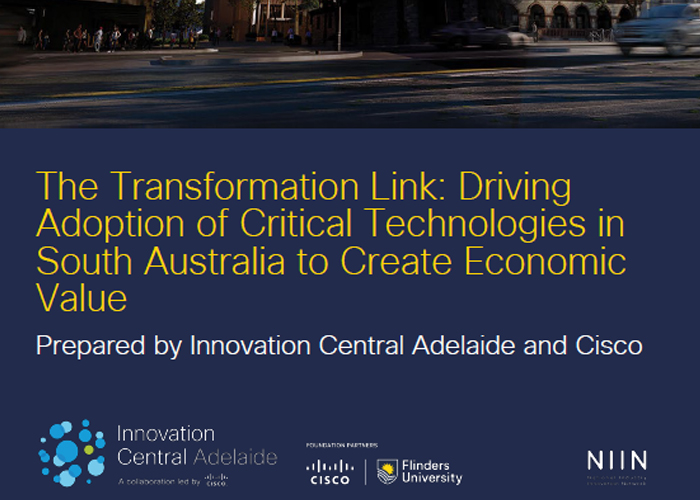
A new report launched this month is urging South Australia to position itself as Australia’s leading testbed and user of artificial intelligence (AI) and other critical technologies, arguing the state has a “once-in-a-generation” opportunity to prove, scale and govern emerging systems in real-world settings.
The report’s authors say SA’s major industries — including health, resources, advanced manufacturing, space and defence — could play a leading role in adopting critical technologies “responsibly and at scale” to create economic value and competitiveness.
“AI and critical technologies are moving rapidly from experimentation into real-world adoption. The organisations that build capability, test solutions and take practical steps now will be best positioned to create value and competitive advantage,” said Dr Kathryn Anderson from Innovation Central Adelaide, based at Flinders University’s Tonsley campus.
The report references forecasts that AI could contribute $115 billion annually to the Australian economy by 2030, largely through productivity gains, improved output quality, and new business and jobs creation.
Flinders University Professor Trish Williams, National Industry Innovation Network (NIIN) Research Chair in Digital Health, said South Australia’s advantage would come from being a place where technologies are applied, proven and scaled, rather than trying to outspend larger jurisdictions on research.
The report outlines three priorities: positioning South Australia as a national environment for trialling and scaling emerging technologies; supporting industry adoption at scale through access to testbeds, expertise and capability-building programs across areas including AI and cybersecurity; and building a workforce of engineers, technicians, researchers and digital professionals able to deploy and operate next-generation systems.
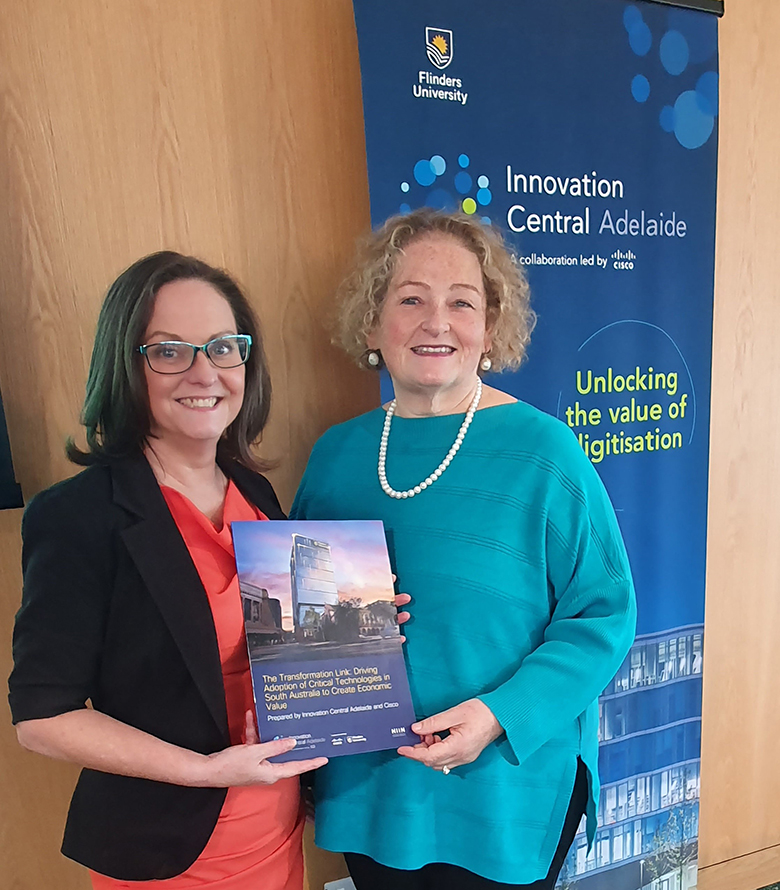
At the report’s launch, Dr Nathalie Taquet, Senior Officer, Strategy and Digital at the Central Adelaide Local Health Network (CALHN), presented on AI use cases in healthcare, including remote patient monitoring, support for medical image interpretation, operational improvements and reducing administrative burden.
Her presentation also emphasised that successful AI deployment depends on governance, risk assessment, workforce capability and ethical oversight. “AI is no longer a future possibility for healthcare but a present reality. Our focus must now shift from adoption to impact, ensuring AI solutions are implemented safely, governed responsibly, and scaled in ways that deliver meaningful value for patients, clinicians and organisations,” she said.
The report, titled ‘The Transformation Link: Driving Adoption of Critical Technologies in South Australia to Create Economic Value,’ and the related ‘AI Pathway for Business’ initiative are described as a collaboration between Flinders University experts and Cisco through the NIIN.
You can read the full report here.