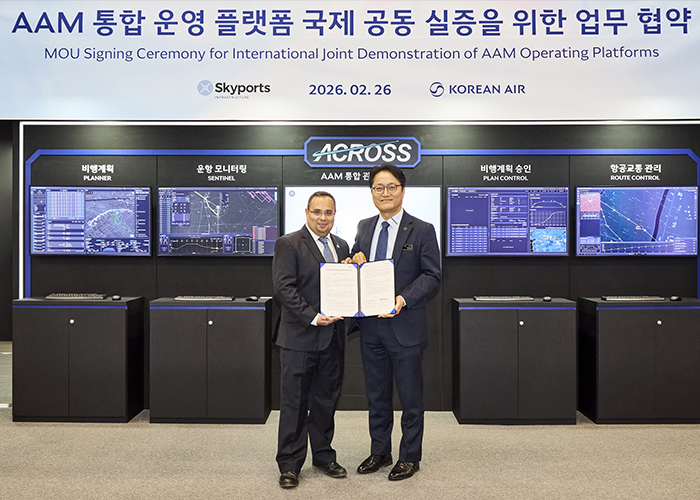
Korean Air has signed a Memorandum of Understanding with Skyports Infrastructure to jointly develop an integrated operating platform for electric vertical takeoff and landing (eVTOL) aircraft, as Advanced Air Mobility (AAM) projects move closer to early commercial deployment.
The agreement was formalised in Busan, with senior executives from both companies in attendance. The partnership will combine Korean Air’s ACROSS (Air Control & Routing Orchestrated Skyway System) with Skyports’ Vertiport Automation System (VAS) to create a unified platform managing both flight operations and ground infrastructure.
The proposed system aims to link air traffic management, fleet operations and vertiport control into a single digital ecosystem capable of overseeing the end-to-end passenger journey. This includes vertiport check-in, security screening, boarding and arrival procedures — areas that remain operationally complex as urban air mobility concepts transition from demonstration to commercial viability.
Korean Air’s ACROSS platform, developed in 2024, is designed to manage low-altitude traffic environments, integrating flight scheduling, route planning, fleet management, maintenance oversight and flight monitoring. The airline was the first domestic operator to secure Urban Air Mobility (UAM) traffic management demonstration status in South Korea, validating ACROSS through Phases 1 and 2 of the government-led K-UAM Grand Challenge overseen by the Ministry of Land, Infrastructure and Transport.
Skyports, meanwhile, is focused on the ground segment of AAM, developing and operating vertiport infrastructure in multiple markets. The company is preparing for commercial operations in Dubai in 2026, alongside projects in Abu Dhabi and the planned conversion of New York City’s Downtown Manhattan Heliport into an AAM-ready facility.
By integrating ACROSS and VAS, the two companies aim to address one of the sector’s key bottlenecks: interoperability between airborne systems and ground infrastructure. Managing dense, low-altitude traffic in urban environments requires coordinated airspace control, vertiport scheduling, charging management and passenger processing — all under regulatory oversight that is still evolving.
A Korean Air representative said ACROSS is built to provide integrated flight control and traffic management for low-altitude aviation, including eVTOLs, drones and helicopters. As vertiports become operational hubs for these aircraft, seamless integration with infrastructure systems is seen as essential to ensuring safety, efficiency and scalability.
The partnership includes plans for joint demonstrations and pilot programmes in regions identified for early AAM commercialisation. While specific deployment timelines have not been detailed, the collaboration signals an effort to move beyond standalone technology development toward full ecosystem readiness.
The broader AAM sector continues to face regulatory, certification and economic hurdles, particularly around airspace integration, public acceptance and infrastructure investment. However, partnerships that combine airline operational expertise with dedicated vertiport developers suggest a maturing approach focused on system-level integration rather than isolated vehicle testing.
If successful, the Korean Air–Skyports platform could serve as a template for other urban air mobility markets seeking to synchronise flight operations with automated ground infrastructure, positioning both companies within the emerging global eVTOL ecosystem.